My first PubMed search and the limitations of neuroscientific explanations
In the case of something as wonderfully complex and socially-constructed as sexual orientation, it’s unlikely we’ll find it staring back at us on an MRI, a genome sequence, or our own hands.

I joined my first research lab in 2008. I was a summer intern at Louisiana State University, in a lab that studied opioid drug addiction and its aftereffects. It was the first time I had seen neuroscience research in action — in practice, it was the first time I’d held and been bitten by a rat. Okay, several rats.
It was also the first time I’d seen PubMed. My mentor showed me how to look up papers related to our work. While she patiently looked over my shoulder, I searched “prenatal exposure to opioids” and “sex differences in drug administration routes.”
When she wasn’t looking over my shoulder, I was searching for different things.
—
Summer 2008 was also my first summer with a girlfriend. I started college with a high school boyfriend and thought I liked boys until I met someone who made me realize I didn’t really like boys. Once I met my first girlfriend, I had never wanted to spend so much time with anyone in my whole life. Sorry, boys.
But I had a problem: I was raised very Catholic. I’d heard various priests in rooms cavernous and intimate tell me that it was a Man and a Woman, period. I was part of a reasonably progressive church but that didn’t mean you could be gay. I had witnessed a million Catholic youths crying out in unison for Jesus on a field in front of the Pope but I had never seen two girls kiss.
I also couldn’t deny the way I felt. Dating someone I actually had feelings for not only made genuine relationships possible, but it confirmed something I’d felt my whole life: I was different.
I started wondering if I could find explanations for that difference in neuroscience, the field I was just learning to love.
—
Research with rodents can be gnarly. In addition to the biting, there’s the pesky fact that you often want to inspect their brains after you’re done injecting them with drugs and measuring how hard they’re willing to work for even more drugs. And excavating brains is a tricky, bloody thing.
I thus learned that I tend to faint at the sight of a lot of blood. I ruled out med school on the spot.
I recovered from my almost fainting (but not my embarrassment) in a private back room of the lab, with the computer where I stored my secret folder of research. Thankfully, it was my computer for the summer, and my mentor graciously decided that I needed the afternoon to rest. And so, back to PubMed.
—
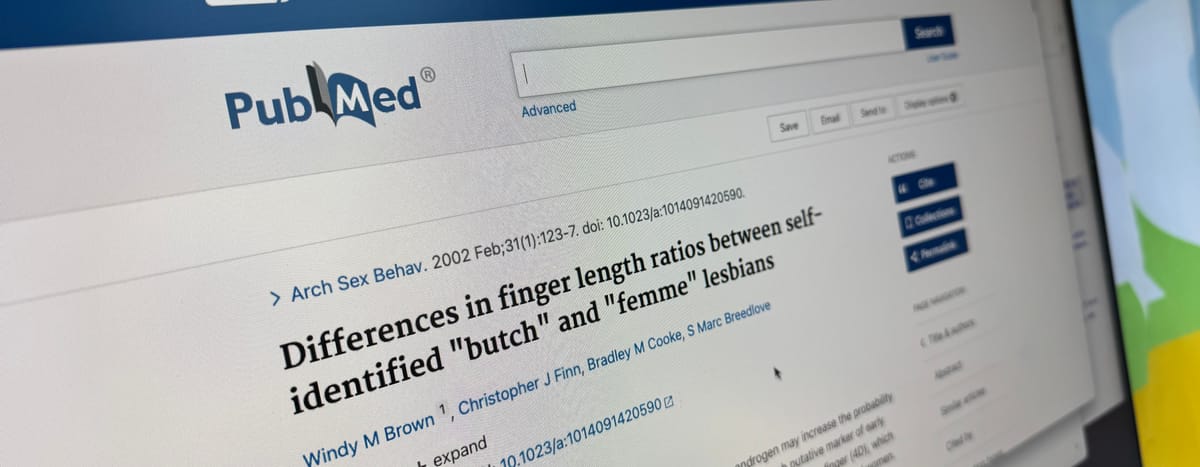
Almost 20 years ago, very few people were studying the biology of homosexuality. A quick, novice PubMed search would have landed you on a few strands of ideas about the sizes of different brain regions or how sexual orientation develops neurologically. I stumbled on two intriguing papers: “A difference in hypothalamic structure between heterosexual and homosexual men” (1991) and “Differences in finger length ratios between self-identified "butch" and "femme" lesbians” (2002). Not being a gay man, I clicked on the latter.
A few clicks later, I’d pieced together a line of research that goes something like this: if people have more androgens, they tend to have second and fourth digits that are closer in size, a relationship expressed as the ratio of length of those fingers: 2D to 4D. Women have a higher 2D:4D ratio than men, heterosexual women have a higher 2D:4D ratio than homosexual women. Femme lesbians might have a higher 2D:4D ratio than butch lesbians, but the data is slim.
I read the paper and immediately looked at my hands. My ring finger is just slightly longer than my index finger, giving me a pretty queer looking 2D:4D ratio.
Like any good scientist I had solved the mystery of my own experience in the world. My fingers were gay, so I was definitely gay.
—
There is a shocking amount of research on digit length and sexuality — even Alice on The L Word knew about this idea.
The prevailing scientific theory is that the 2D:4D ratio is driven by how much testosterone babies are exposed to in the womb. Testosterone may, via epigenetic modification, impact the length of our fingers.
Even still, this is just an interesting observation, one thousandth of the degree of causality of seeing a tumor in your brain and calling it cancer. It’s a whiff of intriguing exhaust from the tailpipe of a machine that we hardly understand, like so much of this kind of research that seeks to map complex social behaviors onto the brain.
Don’t get me wrong — data from our brains and bodies can be life saving. Last year, a close friend of mine found cancer in his brain in one of those images. A few months after that, another beloved person in my life found Alzheimer’s. The ability to look deep into their brains has given them both a chance to shoot lasers and monoclonal antibodies inward. It has offered them second lives.
But in the case of something as wonderfully complex and socially-constructed as sexual orientation, it’s unlikely we’ll find it staring back at us on an MRI, a genome sequence, or our own hands.
No one can look into your brain and tell you who you are.
—
Back at home I had to justify to my parents why I was dating a woman now. “I was born this way,” I’d tell them, an anthem that the LGBT community was quickly adapting. Just look at my fingers.
My reasoning was that if God (the eternal womb) made me this way, it was out of my control. Oh, but Catholicism has an answer to this: fine, just don’t act on it. God made you this way but he didn’t want you to feel this way.
I had presented the research — both firsthand and peer-reviewed — to my parents, and it didn’t matter. Our brains are also plastic, neuroscience research was continuing to emphasize. My dad sent me pamphlets for conversion camps.
—
If we prioritize neuroscientific explanations over other forms of evidence, we get caught in an inevitable bind. The momentary relief I felt from seeing a biological explanation for my queerness ultimately led to disappointment. I wasn’t saved by my biology. In the same way, our cataloging of the wide range of possibilities in any number of named differences may only provide temporary solace. Biological explanations don’t always provide understanding into who we are, they just put who we are in different terms.
Other people with less gay 2D:4D ratios may themselves feel betrayed by Science. Who’s to say they don’t want to love people that they love, just because? Do we have room for that kind of explanation in our acknowledgement of queerness, of neurodivergence, of difference?
These days, you could write an entire PhD thesis on how the brains and bodies of queer people look different, but I’ve stopped turning to research for validation. My found family — who accepts me for who I am and encourages me to live my life as I want — has done more for my psychological well-being than papers published in the highest scientific annals.
Neuroscience can be a wonderfully enlightening lens for those of us that want to see ourselves in the data and who want to feel like we are a part of the patterns of humanity, but it isn’t everything.
In case you’re curious, here are the papers referenced above:
Differences in finger length ratios between self-identified "butch" and "femme" lesbians - PubMed
Finger-length ratios and sexual orientation | Nature
A Difference in Hypothalamic Structure Between Heterosexual and Homosexual Men | Science